THE CAST: W/C J.E.S Hill D.S.O. (aka Growly) and F/O Peter Hallas
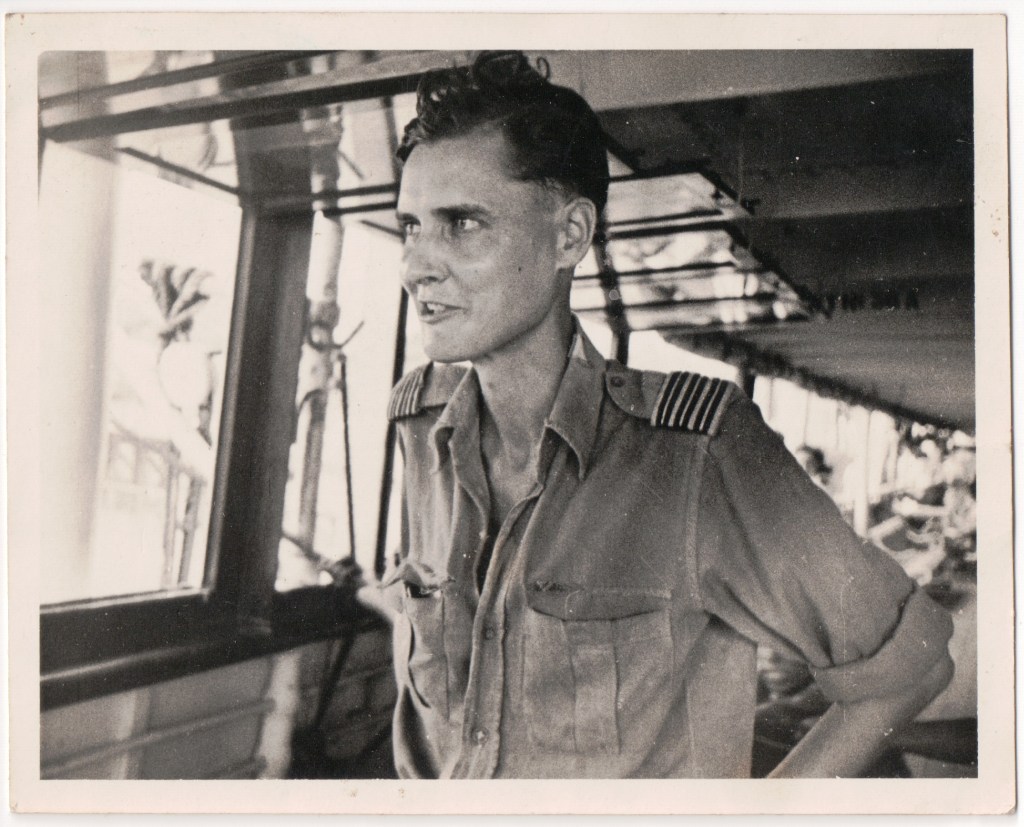
John Elliott Scott Hill (aka Growly – Mouse’s future husband) was a pilot in 177 Squadron, 901 Wing (the Beaufighter wing), based in Chiringa, Burma during 1944, and on 5 October 1944 he (W/C – Wing Commander – John Hill) and navigator F/O G.W. Broughton set out on a sortie at 09.45. They were patrolling ‘the communications networks in a quadrangle in central Burma from Magwe to Monywa in the west and Nantok to Maymyo in the east’ (Silently into the Midst of Things) – but didn’t return from the sortie. What actually happened to them was not known by their fellows until after the war.
Shot down
It turns out that they were shot down by Oscars and captured pretty swiftly afterwards, and John was imprisoned in Rangoon Jail. There is coverage of his imprisonment in the blog post here. But to concentrate on the period surrounding VE Day. What was happening to him at the time that war in Europe came to an end?
VE Day 1945 – Victory in Europe Day – was first celebrated on 8th May 1945, with the victory of the Allied forces against the Axis powers (Nazi Germany etc) in the Second World War. While VE Day saw the end of the war in Europe, it continued to be waged in the Far East – where our ancestor John was – for a further three months. So, it’s a bit of a nonsense of mine to want to see what the ‘VE Day’ experiences of an ancestor serving in the Far East were like. But I wanted to – as I feel it’s important to know what actually happened to our family members, and not just get the headline version of history. So let’s continue with John Hill’s story.
As it turns out, by VE Day 1945, John Hill had already been freed from imprisonment by the Allies. This is how the events unfolded.
Final days of captivity
On 25th April 1945, the Japanese guards marched about 350 British Prisoners of War, and 76 American PoWs, out of Rangoon Jail. However, 150 POWs, who were too ill to march, were left behind, under the charge of some lackadaisical Japanese guards.
On 29th/30th April 1945 (both dates are given in different places), the POWs became aware that the guards had abandoned the jail – so effectively they were no free to leave – that is, if they hadn’t been so desperately ill, and if they wouldn’t have faced imminent danger. So the remaining POWs decided the best course of action would be to barricade themselves inside the jail, and to make it clear to the advancing Allied army not to attack and score an own goal. To that end they climbed on the roof of one of the cell blocks and wrote in large white letters ‘Japs gone’ ‘British here’.
Nonetheless 2 May 1945 the jail was ‘skip-bombed’ by a Mosquito (to smash the wall so the PoWs could escape, or to destroy the jail – as part of Operation Dracula?). 12 Beaufighters had set off for Rangoon from 177 Squadron on 2 May too, but only 2 got through due to horrendous rain, lightning etc.
The next day (3 May 1945) they received an air drop of food. That same day the Allies liberated Rangoon jail.
John was transported on HMHS Karapara – the hospital ship that took him and other Rangoon survivors up to Calcutta. The photo of him taken on 9 May 1945 (see above) now has a context – as it very much matches the deck of the Karapara. Compare the photo n this website for instance: https://www.tynebuiltships.co.uk/K-Ships/karapara1915.html
Note too that IWM has video footage of the former POWs leaving the gaol and boarding the Karapara. This is just one of the links: https://www.iwm.org.uk/collections/item/object/1060030990
Memories
Over the years I have emailed a Family Tree reader Matt Poole, and we’ve shared notes and he’s kindly put me in the direction of fascinating information, such as this excerpt from To Burma Skies and Beyond by Group Captain Reg (Lucky) Jordan, DFC AFC.
GC Reg Jordan was on the same ward in the Himalayas as John Hill in 1945, and he writes of looking across from his own hospital bed and seeing John: “Wing Command Hill, his emaciated body covered in ugly sores, was recovering from years of Japanese imprisonment in the Changi gaol in Singapore. Apart from being on a special diet, reinforced with vitamin tablets, he was occasionally turned onto his side to receive an injection: penicillin perhaps. One sensed his recovery would be a long haul.’
John had ‘only’ been imprisoned for months, not years (as stated in the quote above), but it provides a horrific but poignant insight to John’s experiences. He would still have been a young man at the time – 24 years old – despite having had so many years of war experience.
Notes about 177 Squadron
177 Squadron was in the 3rd Tactical Air Force, 224 Group. The wing John Hill served in in 1944 was 901 Wing.
1943-1945: 177 Squadron fought in the Burma campaign and lost 35% of its aircrew – ‘who altogether only totalled 150, and yes were awarded 4 DSOs, 14 DFCs, two DFMs and an MBE’ (Silently into the Midst of Things). John Hill was one of those awarded a DSO, awarded it in October 1945; it was donated by Mouse to the Imperial War Museum.
177 Squadron was disbanded within a week or two of the liberation of Rangoon – on 12 May 1945.
https://www.roll-of-honour.org.uk/Camp_Rolls/Rangoon_Jail/html/liberated_rangoon_jail.htm : accessed 13 April 2025. Info on this website compiled from AIR 40/1855.
Notes about Peter Hallas
Also serving in 177 Squadron was F/L P. Hallas, EO (Flight Lieutenant. Engineering Officer). Peter was Mouse’s brother – who served with her future husband, John. Indeed that is how they met: Peter asked John to look up his sister when John got back to Britain, which he did. They married in June 1946.
Discover more from A home for our family history
Subscribe to get the latest posts sent to your email.
 A home for our family history