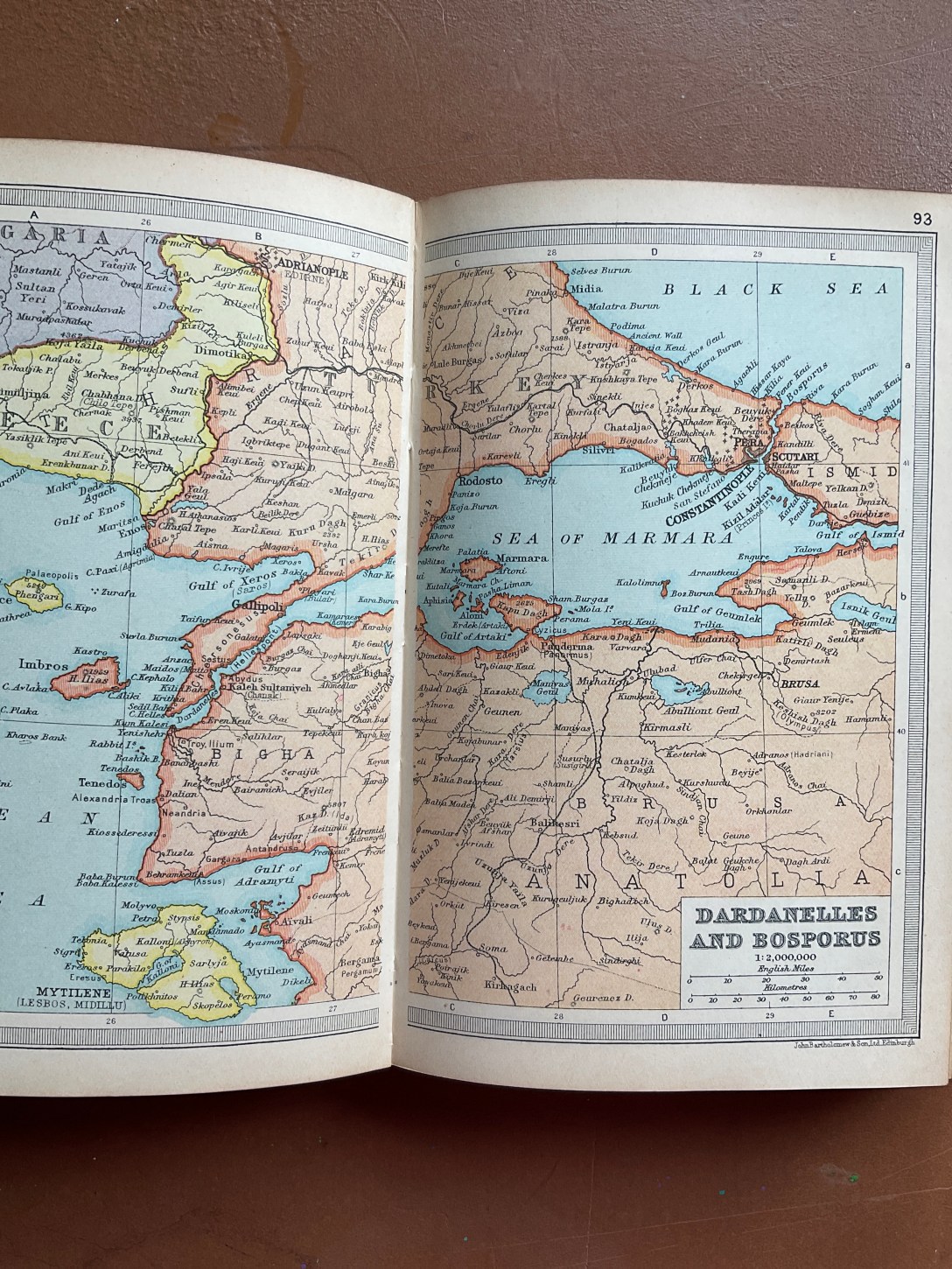
(This is the one who did sketches at Gallipoli of “Cluny’s cave” and was an ambulance driver in the First World War.)
Of my (our) four great-grandfathers, each of whom served in the army in the First World War, John McPherson (father of Rita and Betty) is the hardest to trace.
He returned from Brazil in December 1914 to sign up and can be found sailing back to Brazil in 1919, to carry on working there after the war. But what do we know about his war years?
Overview
John McPherson was an ambulance driver in the RAMC (Royal Army Medical Corps in the First World War). Willi has his medals, and Willi’s cousins have John’s kilt.
It’s always the big question, what someone ‘did in the war’ for those who lived through WW1 and WW2, but for John McPherson I very much get the sense of a person on a mission, focussed on his civilian career, to live in exciting places. He came back to Scotland, early in the war, to volunteer to fight (conscription wasn’t introduced until 1916). Then in 1919, just 7 or so weeks after he was released from his army service, he sailed back to South America to pick up his civilian career.
We know that John didn’t know how to drive a car during WWI (and seemingly he never learnt his whole life long, recalled by Willi), yet he was an ambulance driver. As much medical transport was horse-drawn still at the time, his lack of motorcar skills were no problem, and his skill with horses was an asset.
As an ambulance driver in the RAMC he wouldn’t have carried a weapon. He worked as part of a Field Army Service unit, attached to a brigade, and would have driven one of the horse-drawn wagons. Willi also recalls that, being a skilled linguist, John was sometimes called on to help interpret.
Arriving back in the UK to serve
The ambulance driver who served in the Balkans
What was his life like as a WW1 ambulance driver?
Arriving back in the UK to serve
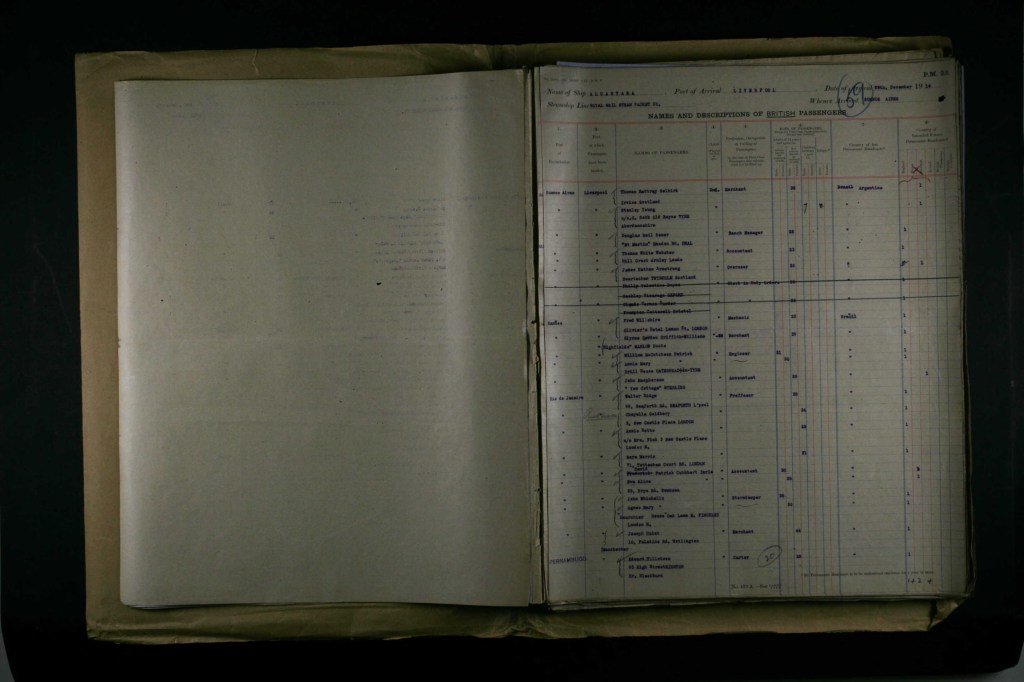
John MacPherson had travelled to South America prior to the First World War, but he can be found returning to Scotland on the Royal Mail Steam Ship Packet Alcantara on 18 December 1914 to sign up to fight [1] and on this inbound passenger list his ‘Intended country of future permanent residence’ is recorded as ‘Scotland’. Address: Yes Cottage, Stirling.
His drawings
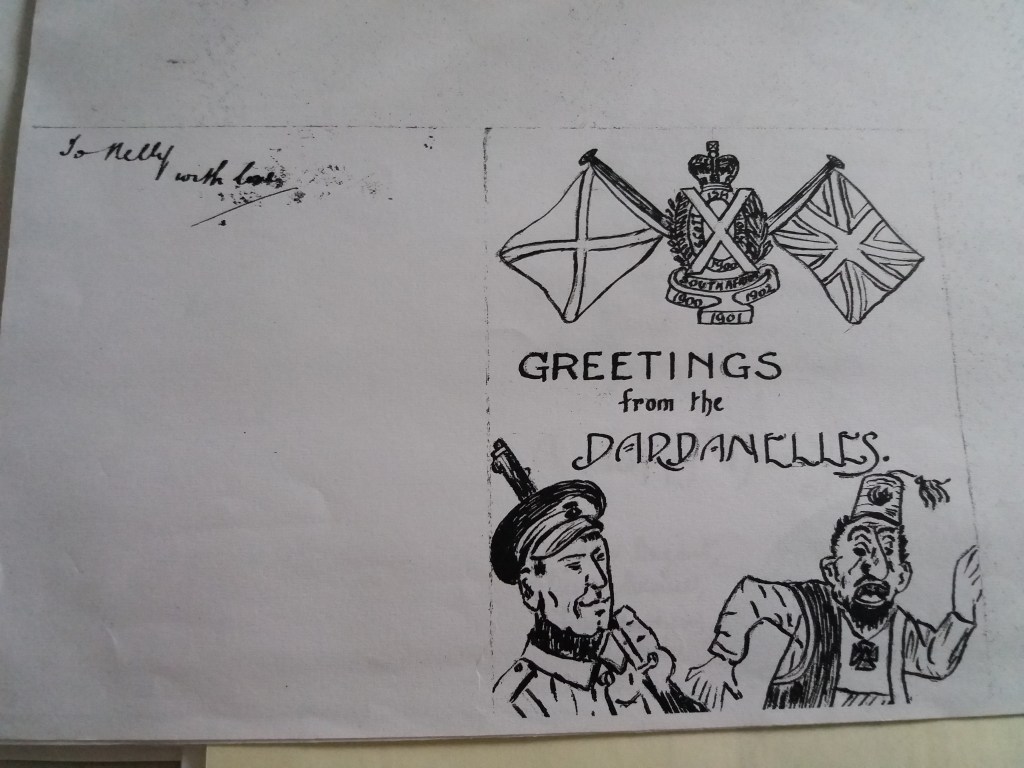
We (the Aunts) have copies of little drawings he did at the Front, humorously labelling his trench/fox hole/dwelling ‘Cluny’s Cave’ (in a nod to Jacobite clan chieftain Cluny McPherson).
The ambulance driver who served in the Balkans

We know that he served at Gallipoli, Aegean Islands, Balkans, in arriving there in September 1915.
The Long Long Trail website has masses of detail: explaining that each Brigade had a Field Ambulance Service attached to it [2]. The website also explains how an ambulance was a unit rather than a vehicle. The unit comprised (rough figures) 230 men, of whom 20 to 30 were drivers, manning 10 ambulance wagons. Of the horses a small number ‘14’ were riding and ‘52’ were used as draught horses. As a member of the Royal Army Medical Corps he wouldn’t have had a weapon. [3]
What was his life like as a WW1 ambulance driver?
This is the key question. And I don’t know the answer. I’m going to try to track down contemporary memories of other people in similar roles. If you have any memories or insights about John and his war years, I would really love to hear and can add them in here.
Medal index card
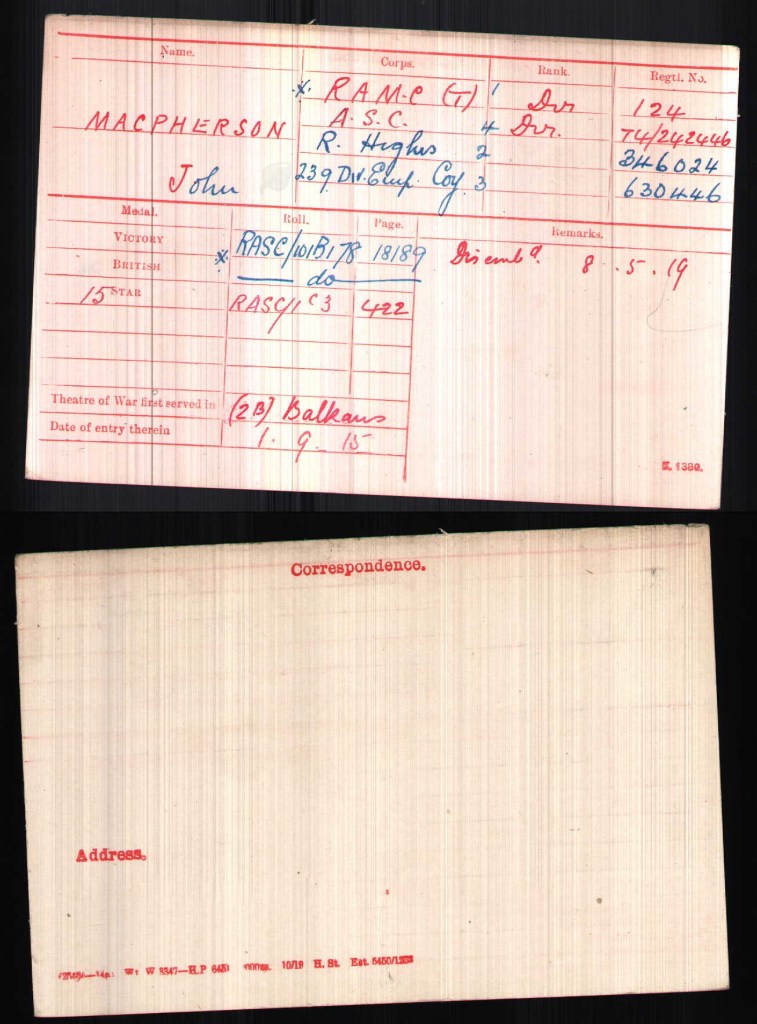
I’ve looked for his army service record, but can’t find it on Ancestry. This is likely because more than half of soldiers’ WW1 records (about 60-70%) were burnt following a fire in Arnhem Street, where they were stored and in WW2.
If anyone manages to find his service records I would love to know. In the meantime what we have to go on are his medal index card [4] and his 1914/15 Star medal roll entry.
This is a decoding of his medal index card.
John MacPherson served as a driver in the Royal Army Medical Corps Transport, then with the Royal Highlanders, then in 239 Divisional Employment Company, then with the Army Service Corps.
The first entered a theatre of war on 1 September 1915 in the Balkans, and he left service on 8 May 1919.
He was awarded the Victory Medal and the British War Medal. As he served in 1915 he was also awarded the 1914-15 Star. This medal and these dates remind us that he volunteered to fight, rather than being conscripted (conscription came in, in early 1916).
Family information always said that John was in the Black Watch and the Scottish Horse too. The detail on the medal index card ‘R. Highs’ is a reference to the Royal Highlanders, aka the Black Watch. The Scottish Horse was a pre-WW1 yeomanry regiment that became the 13th battalion of the Black Watch.
Corps, rank, regimental no, details transcribed from his Medal Index Card:
RAMC(T), Dri, 124
R. Highs, – , 346024
239 Div Emp Coy, – , 630446
A.S.C., Dri, T4/242446
Medal roll entry
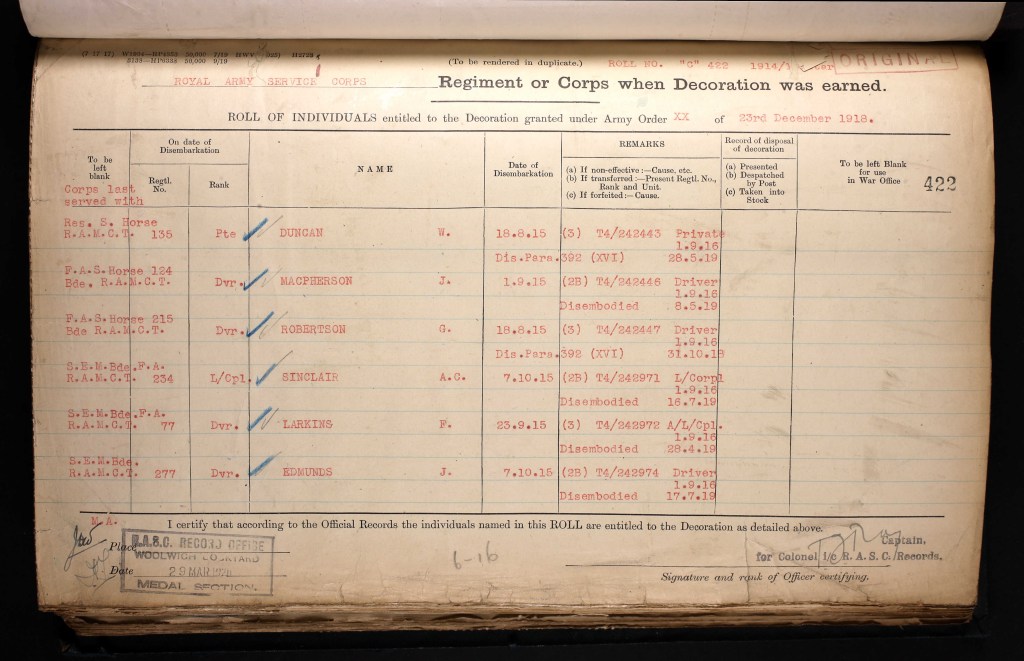
Below, in italics, is a transcription of John McPherson’s details on the 1914/15 Star medal roll [5]. The index card and the roll give slightly different details, so it’s worth looking at both to get all possible clues.
1914/15 Star medal roll. Roll no. C 422. Royal Army Service Corps.
Roll of individuals entitled to the Decoration granted under Army Order XX of 23rd December 1918.
Regimental No: F.A.S. Horse 124 Bde. R.A.M.C.T.
Rank: Dvr
Name: MacPherson J.
Date of disembarkation: 1.9.15
Remarks: (2B) T4/242446 Driver 1.9.16; Disembodied 8.5.19
Notes:
F.A.S. = Field Ambulance Service;
R.A.M.C.T. = Royal Army Medical Corps Transport;
On the medal roll the first column heading says regimental number. But this looks as though it’s his unit details to me as well. I.e. his number was 124. He was in the horse section of the Field Ambulance Service for a Brigade, and served in the Royal Army Medical Corps Transport.
His actual final regimental number is in the remarks column: T4/242446. He would have started off with a different number and each time he changed units it changed. Then in 1917 it would have been changed to a 6 digit one.
T4 denotes that he was in the 4th of Kitchener’s four new armies. [6]
His disembodiment date is the date he left the army, when his unit was disembodied. The term disembodied was used as he was a territorial, as opposed to joining up straight from civvy street. The 4 to 6 digit change was also something that applied to Territorials. [7]
The (2B) preceding his number is a code for the place where he first entered a theatre of war. Such codes were only given for men first deployed up until 31 December 1915. 2B denotes: Gallipoli & Aegean Islands. [8]
Back to civilian life
After the war he resumed his civilian employment, returning to South America in 1919, and on the outbound passenger list for his sailing on the Steam Ship Highland Piper (01 July 1919) his country of ‘last permanent residence’ is again cited as Scotland. [9]
You can read more about John McPherson’s life here…. Soon!
[1] UK Inbound. 29 December 1914. MCPHERSON John. https://www.ancestry.co.uk : accessed 20 November 1914.
[2] https://www.longlongtrail.co.uk/army/regiments-and-corps/royal-army-medical-corps-in-the-first-world-war/the-territorial-mounted-brigade-field-ambulances-of-the-royal-army-medical-corps/ : accessed 01 June 2024.
[3] http://www.longlongtrail.co.uk/soldiers/a-soldiers-life-1914-1918/the-evacuation-chain-for-wounded-and-sick-soldiers/field-ambulances-in-the-first-world-war/ :accessed 01 June 2024.
[4] McPherson, John. medal index card. Ancestry : accessed 01 June 2024.
[5] McPherson, John. 1914/15 Star medal roll. https://www.ancestry.co.uk : accessed 15 October 2020.
[6] https://www.longlongtrail.co.uk/soldiers/a-soldiers-life-1914-1918/letter-prefixes-to-british-soldiers-numbers-in-the-first-world-war/ : accessed 01 June 2024.
[7] https://www.rootschat.com/forum/index.php?topic=779481.0 : accessed 01 June 2024.
[8] https://www.longlongtrail.co.uk/soldiers/how-to-research-a-soldier/campaign-medal-records/how-to-interpret-a-campaign-medal-index-card/medal-roll-theatre-codes/ : accessed 01 June 2024.
[9] UK Outbound. 01 July 1919. MACPHERSON John. https://www.findmypast.co.uk : accessed 20 November 2014.
Discover more from A home for our family history
Subscribe to get the latest posts sent to your email.
 A home for our family history